Percentage of Reported Occupations as Musician/Music Teachers

I ran across a really interesting break down of occupational claims created in a data visualization platform called Flare.  In it you can search for a specific occupation and the percentage that occupation takes up in the work force. If you search for “musician” you find that the number of people claiming this (or music teacher) as their job begins to take a huge tick up in 1970.  I wonder what the cause of this labor shift is. In general, budgets for the NEA seem to have been held constant with inflation or even declined since the 1980s, so it is surprising to see an explosion of people claiming it as their career if we understand the paltry arts support our country gives as limiting educational opportunities or grant support.

On the other hand, we can perhaps understand this explosion in people claiming to be musicians as growth in the commercial industry of music, the tape cassette was invented in 1961, but only really caught on by the end of the decade.
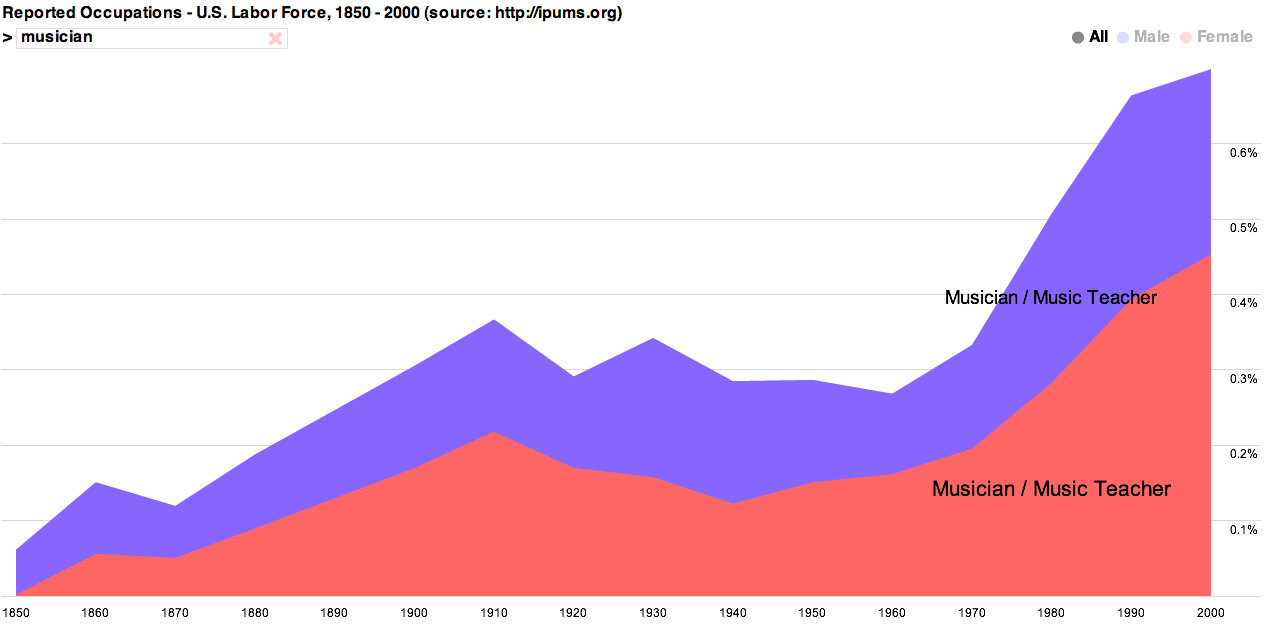
Number of People Claiming Musician/Music Teacher as Occupation

Share and Enjoy:
  • Digg
  • del.icio.us
  • Facebook
  • Google Bookmarks
  • MySpace
  • Reddit
  • StumbleUpon
  • Technorati

4 comments to Percentage of Reported Occupations as Musician/Music Teachers

  • [...] http://opensourcemusic.org/?p=958If you search for “musician” you find that the number of people claiming this (or music teacher) as their job begins to take a huge tick up in 1970. I wonder what the cause of this labor shift is. In general, budgets for the NEA seem to … [...]

  • [...] more here: Open Source Music » Percentage of Reported Occupations as Musician … This entry was posted on Saturday, September 19th, 2009 at 3:12 pm and is filed under News, [...]

  • Nina

    The growth shown in the graph is mostly in women since about the 1970s, when birth control allowed women far greater access to work in general. Also there is no indication of full time or part time. Today many many women work part time as they juggle work and families. You could also wonder if the decline in women 1910-1940 had something to do with so few men being left around from two World Wars that women suddenly had to work full time in such occupations as factory work. Maybve they had to leave their part time music teaching/performing roles and go to work full time elsewhere. Just a thought. Also the small peak in men around 1930 – anything to do with the rise of jazz and dance bands? Followed of course by a dip for World War 2.

  • This would be true is it was merely a graph of the concrete number of people entering the work force, but instead it is the percentage of the labor force. This means that there is likely to be a huge growth of women entering the work force after the 70s, but it doesn’t account for why the number of people claiming this profession started taking up more of a share of the work force. On top of that if you compare the size of the men’s work force in 1970 to that in 2000 it roughly doubles in size, about the same happens for women.

Leave a Reply


You can use these HTML tags

<a href="" title=""> <abbr title=""> <acronym title=""> <b> <blockquote cite=""> <cite> <code> <del datetime=""> <em> <i> <q cite=""> <strike> <strong>